Best Geolocation APIs for Developers
Compare the best geolocation APIs for developers based on geocoding quality, pricing, documentation, IP lookup support, and developer fit.

Best Geolocation APIs for Developers
Geolocation APIs cover more than just maps. Depending on your application, you may need forward geocoding, reverse geocoding, IP geolocation, place search, routing support, or address validation. The best geolocation API is the one that matches the job your app actually needs to do without creating unnecessary pricing or integration complexity.
This guide compares practical geolocation APIs developers often evaluate when building apps that depend on maps, address lookup, location intelligence, and user-context features. For more options, browse the FindAPI Maps APIs category.
What developers should compare in a geolocation API
- geocoding and reverse geocoding quality
- IP geolocation support
- place search and address lookup capabilities
- coverage and international accuracy
- rate limits and free-tier usefulness
- pricing at production scale
- documentation quality
- response structure and ease of integration
If location is a core part of your product, accuracy and pricing matter more than having a very long endpoint list.
Best geolocation APIs at a glance
1. Geoapify
Geoapify is a strong option for developers who want a practical maps and geocoding API product without immediately jumping to the largest mapping platforms. It is often a good fit for apps that need geocoding, reverse geocoding, and places-style workflows in a more straightforward developer package.
Best for: general geocoding, maps, and location search use cases.
2. ipapi
ipapi is useful when your use case is really IP-based location intelligence rather than maps. If you need country, region, city, or related context for personalization, fraud checks, or lightweight enrichment, it is one of the easiest API categories to evaluate.
Best for: IP geolocation, personalization, and fraud-related enrichment.
3. Google Maps Platform
Google Maps Platform is often the default comparison point because of its breadth, documentation maturity, and global familiarity. It is not always the cheapest option, but many teams evaluate it because it covers multiple location workflows under one ecosystem.
Best for: broad location workflows, enterprise familiarity, and teams that want one large mapping platform.
4. LocationIQ
LocationIQ is commonly considered when developers want geocoding and mapping features with simpler pricing than larger mapping ecosystems. It is often worth comparing for teams that care about practical implementation tradeoffs more than big-platform branding.
Best for: geocoding-focused apps and teams comparing simpler pricing models.
5. Mapbox
Mapbox is often part of the shortlist when maps and developer customization matter as much as raw geolocation data. It is especially relevant for teams building more map-heavy products rather than just doing address lookup.
Best for: map-heavy products and teams that want more front-end map customization.
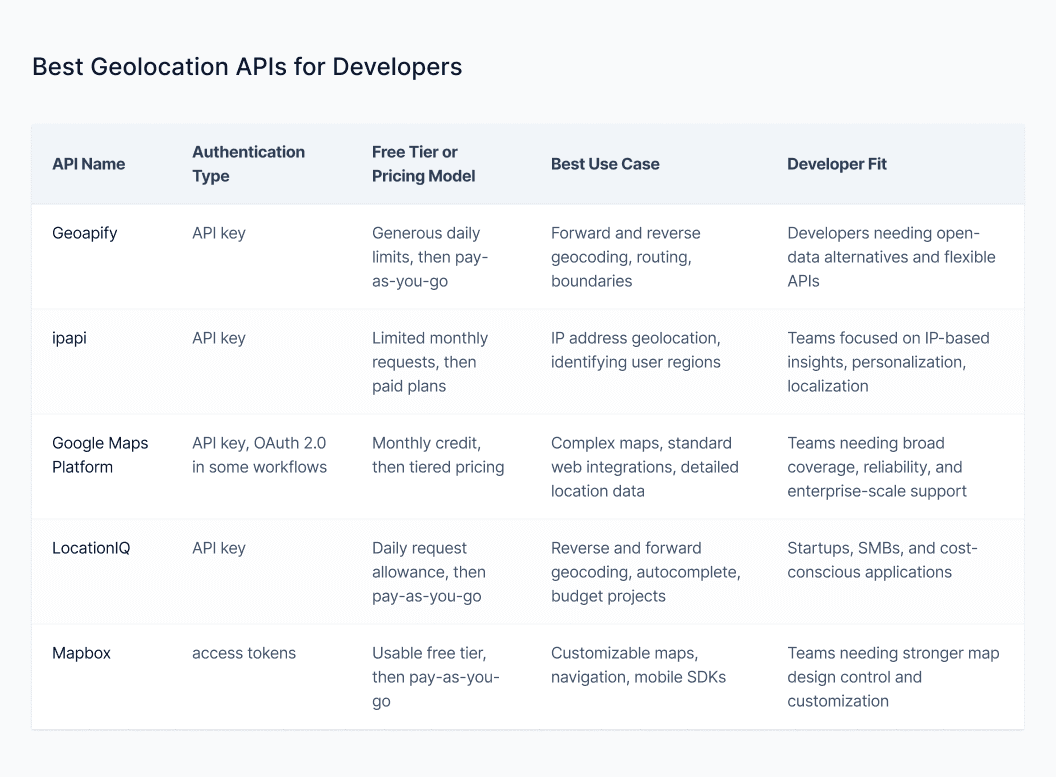
Geolocation API comparison table
| API | Best for | Auth | Free tier | Notes |
|---|---|---|---|---|
| Geoapify | Geocoding and maps | API key | Yes | Good balance of practical location features |
| ipapi | IP geolocation | API key | Yes | Useful for enrichment and personalization |
| Google Maps Platform | Broad location workflows | API key | No | Mature ecosystem and broad coverage |
| LocationIQ | Geocoding-focused apps | API key | Yes | Often compared on pricing simplicity |
| Mapbox | Map-heavy applications | API key | Limited | Strong for customizable map experiences |
Best geolocation APIs by use case
If your app mainly needs address lookup and reverse geocoding, Geoapify and LocationIQ are practical starting points. If your main need is IP-based user context, ipapi is a more direct fit. If maps are central to the product experience, Google Maps Platform and Mapbox usually deserve a closer comparison.
How to choose the right geolocation API
- define whether you need geocoding, IP lookup, maps, routing, or multiple location workflows
- shortlist two or three realistic providers
- compare pricing and free-tier realism against expected usage
- test response quality using real locations and edge cases
- review international coverage if your product is not location-limited
A geolocation API that looks inexpensive at first can become costly once your app grows, especially if requests scale across search, autocomplete, map views, and enrichment workflows at the same time.
FAQ
What is the best geolocation API for developers?
That depends on the use case. Geoapify is a strong all-round option, ipapi is useful for IP-based use cases, and Google Maps Platform or Mapbox may be better for broader map-heavy products.
What should developers compare in a geolocation API?
Developers should compare geocoding accuracy, IP lookup support, pricing, request limits, coverage, documentation quality, and the ease of integrating the API into a real application.
Final take
The best geolocation API is the one that matches your exact location workflow without creating unnecessary cost or complexity. Start with your real use case, compare a focused shortlist, and then test the response quality with realistic inputs before choosing a provider.
To explore more options, compare providers in the FindAPI Maps APIs category.
Tags
About the Author
Tom
Helping developers evaluate APIs more efficiently by writing clear, practical guides on features, tradeoffs, and best-fit use cases.