
Best Weather APIs for Developers
Compare the best weather APIs for developers based on forecast quality, pricing, free-tier access, documentation, and integration fit.

Best Weather APIs for Developers
Weather APIs seem simple until you need one that is reliable, affordable, and practical to integrate into a real product. Developers usually care less about flashy feature lists and more about forecast quality, location coverage, rate limits, documentation, and how painful the API is to work with in production.
This guide compares some of the best weather APIs for developers based on practical evaluation criteria. If you are still exploring providers, start with the FindAPI Weather APIs category to compare more options.
What developers should look for in a weather API
Before choosing a provider, it helps to define what your app actually needs. A simple weather widget and a logistics planning system do not have the same requirements.
- current weather vs hourly vs multi-day forecast support
- historical weather availability
- geographic coverage
- free-tier usefulness
- request limits
- pricing after launch
- location search and geocoding support
- documentation quality
- response structure and ease of integration
If your app depends heavily on weather data, reliability and pricing often matter more than raw endpoint count.
Best weather APIs at a glance
1. Open-Meteo
Open-Meteo is one of the easiest weather APIs to test because it does not require authentication for basic use. That makes it especially attractive for prototypes, hobby projects, dashboards, and early-stage product validation.
Best for: free projects, prototypes, simple forecast integrations.
2. OpenWeather
OpenWeather is one of the most widely recognized weather APIs and is often the default commercial comparison point. It is familiar, broadly documented, and useful for teams that want a provider they can justify internally without much explanation.
Best for: general weather applications, production apps, teams comparing known vendors.
3. WeatherAPI.com
WeatherAPI.com is a practical option when you want a weather API that feels balanced rather than extreme in one direction. It is often useful for teams looking for forecast data plus surrounding weather context in a straightforward developer product.
Best for: product teams that want an all-round weather API, apps that need weather and location context together.
4. Tomorrow.io
Tomorrow.io becomes more interesting when weather is operationally important rather than cosmetic. If your application depends on planning, forecasting, disruptions, or logistics decisions, it may be worth evaluating against lighter consumer-style weather APIs.
Best for: logistics, operations, business forecasting workflows.
5. AccuWeather
AccuWeather remains a relevant option because some teams care about established commercial vendors, procurement familiarity, and brand recognition as much as the technical API itself.
Best for: enterprise evaluation, established commercial products.
Weather API comparison table
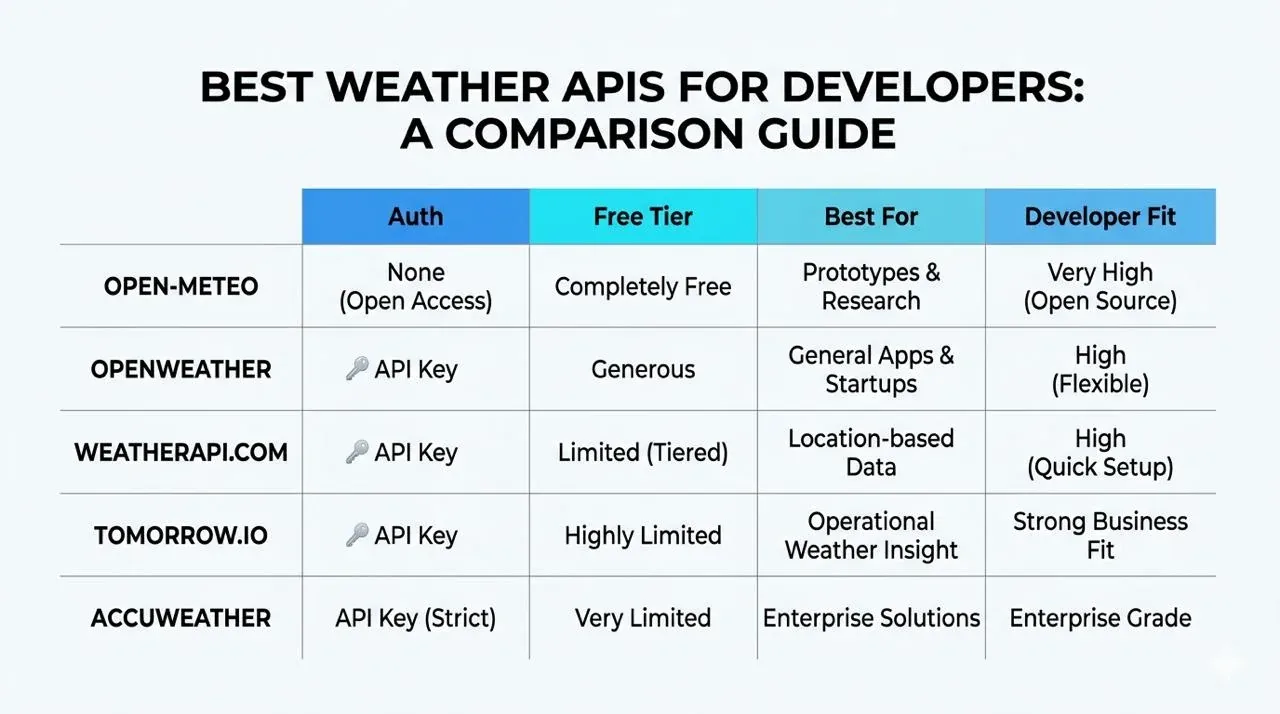
The chart below provides a quick comparison of the main weather API options covered in this guide.
| API | Best for | Auth | Free tier | Notes |
|---|---|---|---|---|
| Open-Meteo | Free forecast integrations | None | Yes | Fast to test and easy to integrate |
| OpenWeather | General weather apps | API key | Yes | Well-known and broadly supported |
| WeatherAPI.com | Forecast + location context | API key | Yes | Good all-round feature mix |
| Tomorrow.io | Operational forecasting | API key | Limited | Better for business-heavy workflows |
| AccuWeather | Enterprise and commercial use | API key | Limited | Strong brand and enterprise fit |
Best free weather APIs for developers
If cost matters most at the start, Open-Meteo is one of the strongest free starting points. It is simple to test, quick to integrate, and useful enough for a wide range of early-stage projects.
OpenWeather is also commonly evaluated because its free tier is accessible enough for initial testing, though long-term economics and limits should still be checked before launch.
The key question is not whether a weather API has a free tier. It is whether the free tier is useful enough to validate a real workflow before you commit engineering effort.
How to choose the right weather API
- define the exact use case
- shortlist two or three realistic providers
- compare forecast depth, pricing, and docs
- test the response structure in a real request
- review what production usage will actually cost
A weather API that looks good in a pricing table can still be a poor fit if its docs are weak, its location model is awkward, its free tier is too limited to validate your use case, or its pricing becomes expensive once usage grows.
The best choice is usually the provider that fits your actual product requirements with the least long-term friction.
When to choose a simple provider vs a commercial one
A simpler provider is usually enough when weather is a secondary product feature, you need basic forecasts only, or you are building an MVP or internal tool.
A more commercial or enterprise-oriented provider makes more sense when weather is core to user decisions, downtime or forecast quality affects operations, or buyers need vendor confidence and support expectations.
FAQ
What is the best weather API for developers?
That depends on the use case. Open-Meteo is a strong free starting point, OpenWeather is a familiar mainstream option, and Tomorrow.io may be better for more operational or business-critical use cases.
What is the best free weather API?
For many developers, Open-Meteo is one of the best free weather APIs because it is fast to test and useful immediately.
What should developers compare in a weather API?
Developers should compare forecast depth, coverage, pricing, free-tier value, documentation quality, rate limits, and the ease of integrating the API into a real application.
Final take
The best weather API for developers is not always the one with the most features. It is the one that fits your product needs, your usage model, and your budget without creating unnecessary complexity.
If you want to explore more providers, compare options in the FindAPI Weather APIs category.
Tags
About the Author
Tom
Helping developers evaluate APIs more efficiently by writing clear, practical guides on features, tradeoffs, and best-fit use cases.